

Clinical research in supplements: How science ensures safety
TL;DR:
- “Clinically tested” on supplement packaging often lacks clear meaning, as true clinical research involves formal human trials testing safety and efficacy. Such research requires predefined endpoints, placebo controls, adequate sample sizes, and objective measures to produce reliable, generalisable results. Consumers should scrutinise study design, funding, and regulatory context to determine the trustworthiness of supplement claims.
The phrase “clinically tested” appears on supplement packaging constantly, yet most people have little understanding of what it actually involves. Clinical research in supplements means conducting human trials to assess safety, tolerability, and health-related outcomes using formal trial methodologies, not simply running a laboratory experiment or surveying satisfied customers. When you know how this research works, you are in a much stronger position to evaluate which products deserve your trust and which ones are trading on loosely applied scientific language.
Table of Contents
- What does clinical research in supplements mean?
- Key components of supplement clinical trials
- Regulatory standards and why they matter
- Challenges and pitfalls in supplement research
- What successful supplement trials look like: The COSMOS example
- The hard truth: What clinical research really means for your supplement choices
- How to find supplements backed by science
- Frequently asked questions
Key Takeaways
| Point | Details |
|---|---|
| Rigorous evidence matters | Human clinical trials are essential for establishing both safety and effectiveness in supplements. |
| Not all studies are equal | Quality trials use controls, clear endpoints, and robust methods that filter out chance findings. |
| Regulations guide claims | The regulatory standard behind a study shapes which supplement claims are credible and actionable. |
| Be sceptical and informed | Recognising challenges like poor standardisation and small studies helps you avoid misleading supplement claims. |
What does clinical research in supplements mean?
The term “clinical research” is frequently misused in supplement marketing. It is worth being precise about what it actually requires. Human studies to test safety and efficacy using formal trial methodologies separate genuine clinical research from the anecdotal reports, testimonials, and in-vitro (cell culture) experiments that are often dressed up to sound more authoritative.
Anecdotal evidence involves individuals reporting their personal experiences with a supplement. These accounts are not without value, but they cannot account for placebo effects, natural recovery, or the dozens of other variables that influence how a person feels. Clinical research, by contrast, uses controls, standardised measurements, and defined endpoints to test whether an observed effect is genuinely caused by the supplement.
The table below illustrates the key differences:
| Type of evidence | Setting | Controls used | Generalisable? |
|---|---|---|---|
| Anecdotal / testimonial | Individual experience | None | No |
| In-vitro / animal study | Lab or animal model | Limited | Partially |
| Observational study | Real-world populations | Partial | Moderate |
| Randomised controlled trial | Human volunteers | Yes, placebo | Yes |
Key characteristics that define clinical research in supplements:
- Involves human participants, not cell cultures or animals
- Uses formal study design, such as randomised controlled trials (RCTs)
- Measures predefined outcomes, whether biomarkers, physical function, or disease risk
- Follows safety monitoring protocols throughout the trial period
- Is subject to independent scrutiny, including ethical review boards
Understanding supplement safety basics is a useful starting point before interpreting any trial data. Safety and efficacy are two separate domains, and a well-designed trial must address both.
Key components of supplement clinical trials
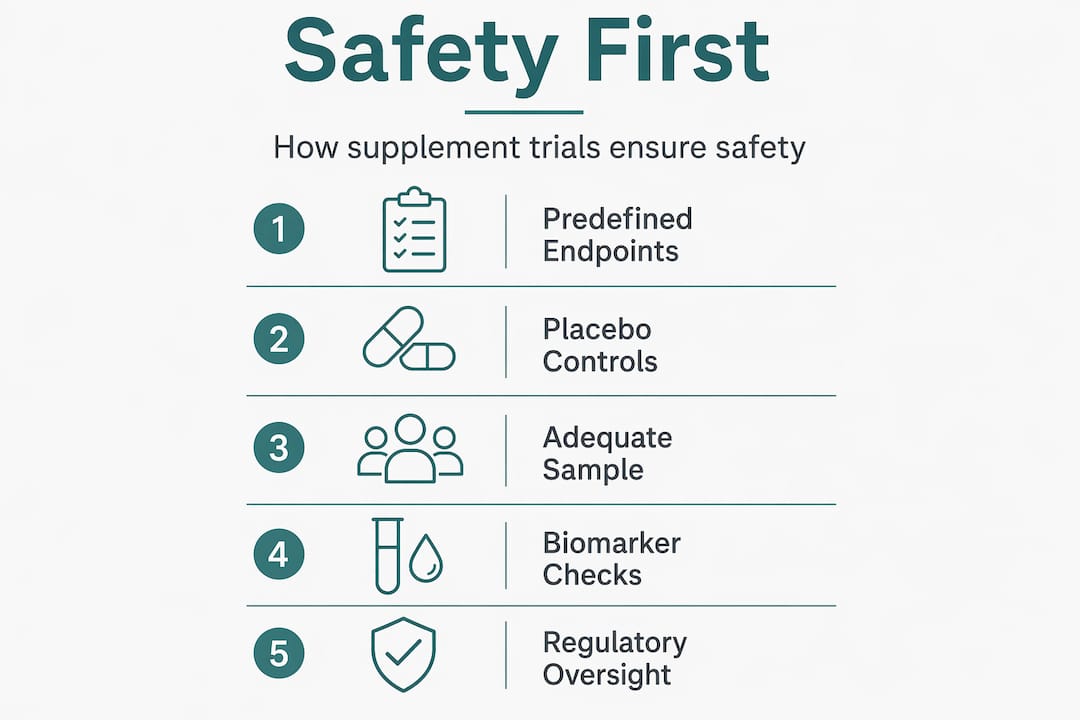
Now that the definition is clear, the next question is what separates a high-quality supplement trial from a weaker one. The structure of a trial determines how much confidence you can place in its results.
1. Predefined endpoints Before a trial begins, researchers must specify exactly what they are measuring. These are called endpoints. A primary endpoint might be a specific biomarker such as blood pressure, inflammatory markers like CRP, or cognitive performance scores. Secondary endpoints may track broader outcomes. Trials that shift their focus after seeing results are vulnerable to “outcome switching,” which inflates the chance of a false positive finding.
2. Control groups and placebo design The gold standard for supplement trials is the double-blind, placebo-controlled design. Participants are randomly assigned to receive either the supplement or an identical-looking placebo, and neither participants nor researchers know who received which. This controls for the placebo effect, expectation bias, and researcher influence. Mechanistically, supplement clinical research combines predefined endpoints with biomarker or functional measures, alongside safety monitoring and statistical methods that separate chance from real effects.

3. Sample size and statistical power A study with only 20 participants cannot reliably detect moderate effects. Statistical power refers to a trial’s ability to detect a real effect when one exists. Larger samples produce more reliable estimates. Small trials are not worthless, but their results should be treated as preliminary.
4. Biomarkers versus subjective measures Some trials use objective biomarkers such as blood glucose, bone density, or lipid profiles. Others rely on self-reported measures such as fatigue ratings or wellbeing scores. Both have value, but subjective measures are more vulnerable to placebo effects. Knowing which type was used helps you assess the robustness of the findings.
| Trial feature | Stronger evidence | Weaker evidence |
|---|---|---|
| Blinding | Double-blind | Open-label |
| Controls | Placebo-controlled | No control group |
| Sample size | Hundreds or more | Under 50 |
| Endpoints | Predefined and objective | Post-hoc or subjective |
| Duration | Long enough for effect | Very short |
Pro Tip: When assessing a supplement’s claimed research, look up the actual study on PubMed or a similar database and check the sample size, whether a placebo was used, and who funded the research. Manufacturer-funded trials are not inherently invalid, but independent replication strengthens confidence significantly.
For practical guidance on measuring supplement effectiveness, tracking your own biomarkers alongside any supplementation programme gives you a personalised data point to complement the published literature.
Regulatory standards and why they matter
Understanding clinical research also requires knowing how regulations shape which studies are conducted and what claims may follow from them. This context is particularly relevant for European consumers who may encounter supplements backed by studies conducted under varying regulatory frameworks worldwide.
In the United States, supplements are not approved by the FDA before they reach the market. However, when researchers conduct clinical trials on supplements, the regulatory picture becomes more nuanced. Whether an IND application is required depends on the study’s intent and design, and only the FDA can determine those requirements. Trials that aim to establish a health claim or test a supplement in a disease population are more likely to require an Investigational New Drug application than basic safety or tolerability studies.
Why does this matter for you as a consumer?
- Studies conducted under IND oversight tend to follow stricter protocols, including formal safety monitoring and adverse event reporting.
- Studies conducted without IND may have fewer oversight requirements, which does not invalidate them but does mean the methodology must be scrutinised independently.
- European regulatory standards under the European Food Safety Authority (EFSA) govern which health claims can appear on labels sold within the EU. Claims that pass EFSA review are typically grounded in consistent clinical evidence across multiple studies.
- Claims that sound specific but lack regulatory backing are a common marker of lower-quality evidence.
When reviewing a supplement’s research credentials, knowing whether the supporting trial was conducted under formal regulatory oversight, and in which jurisdiction, helps you judge the reliability of the claimed outcome. Understanding supplement labels in this regulatory context makes it much easier to distinguish substantiated claims from marketing language.
Challenges and pitfalls in supplement research
Even when a trial follows the right structure, practical challenges can undermine the value of its results. Recognising these pitfalls helps you approach “clinically proven” claims with appropriate scepticism.
Product standardisation One of the most significant problems in supplement research is that the product used in the trial may not match what is sold commercially. Herbal extracts, for example, can vary substantially in their concentration of active compounds depending on the source, growing conditions, and manufacturing process. Product standardisation and quality control issues directly affect what the trial actually tests, making it difficult to know whether a commercial product will produce the same result as the one studied.
Common pitfalls to watch for:
- Small sample sizes that lack statistical power and cannot detect modest effects reliably
- Short study duration that fails to capture long-term benefits or delayed adverse effects
- Poorly validated outcome measures that do not reflect clinically meaningful change
- High dropout rates that skew results in favour of the supplement
- Inadequate placebo design where participants can identify whether they received the active supplement
- Absence of independent replication meaning results have not been reproduced by other research teams
Red flags in research claims:
Look for language such as “based on research” without specifying the study type or population. Be cautious when a brand cites a single in-vitro study, an animal study, or a trial conducted exclusively by the manufacturer with no independent oversight. Phrases such as “studies suggest” can cover an enormous range of evidence quality, from a single small pilot trial to a large meta-analysis.
Pro Tip: Search for the study in a peer-reviewed database. Check whether the results have been replicated, and note the funding source. A manufacturer-funded study showing large benefits that has not been replicated independently warrants careful scrutiny.
Accessing evidence-based supplement use guidance tailored to older adults helps translate these critical thinking tools into practical daily decisions.
What successful supplement trials look like: The COSMOS example
Seeing these principles applied to a real trial clarifies how clinical research translates into actual consumer decisions. The COSMOS trial is one of the most instructive recent examples.
COSMOS (COcoa Supplement and Multivitamin Outcomes Study) was a large-scale randomised trial involving over 21,000 participants. It tested both cocoa extract and multivitamin/multimineral supplementation against placebo over several years. In an ancillary analysis focused on epigenetic ageing, multivitamin supplementation produced modest changes in epigenetic ageing clocks, while cocoa extract did not show effects in the prespecified ancillary analysis.
“Even in a rigorously designed, large-scale randomised clinical trial, effects on complex biological ageing markers may be modest, inconsistent between interventions, or limited to specific subgroups.”
What can you take from this?
- Rigorous design does not guarantee dramatic results. COSMOS was well-powered, double-blind, and placebo-controlled, yet outcomes were nuanced.
- Statistically significant does not mean life-changing. A measurable effect on an epigenetic clock does not automatically translate into meaningful changes in how you feel or function day-to-day.
- Different interventions behave differently. Multivitamins and cocoa extract showed distinct result patterns even within the same trial framework.
- Pre-specified versus post-hoc results matter. The epigenetic analysis in COSMOS was an ancillary analysis, meaning it was not the primary endpoint. Results from pre-specified primary endpoints carry more weight.
- Population matters. COSMOS enrolled primarily older adults, making it more directly relevant to those aged 40 and above seeking evidence for supplement use in the context of healthy ageing.
For a broader look at evidence for older adults and how major trials inform supplement decisions, reviewing the primary literature alongside expert summaries gives the fullest picture.
The hard truth: What clinical research really means for your supplement choices
Here is a perspective that most supplement marketing will not offer you. The existence of a clinical trial is not, by itself, a reason to buy a product. The relevant question is far more specific.
The most useful question is not “did a study show something?” but rather “was the outcome pre-specified, measured well, and did the study have enough power and appropriate controls, with results that are not just statistically significant but also potentially meaningful?” That is the standard worth holding supplement research to.
Most supplement advertising does not reach that standard. Terms like “clinically studied,” “research-backed,” and “scientifically supported” are applied to products where the supporting evidence may be a single small pilot trial, an animal study, or a study examining an entirely different form of the ingredient than what is in the product you are buying.
The counter-intuitive truth is that the most rigorous trials often produce the least exciting headlines. They show modest effects in specific populations, with important caveats about study duration or the characteristics of participants. This nuance is not a failure of science. It is a strength. It means the results reflect something real rather than something inflated.
For health-conscious adults over 40, the practical implication is this: prioritise supplements that have been tested in human trials, on participants similar to you in age and health status, with clear endpoints and independent replication. A supplement guide for healthy ageing grounded in this standard is far more useful than one that simply lists ingredients with impressive-sounding study references.
Ask better questions of the research. Demand real-world relevance. Reward transparency.
How to find supplements backed by science
Applying this knowledge to actual purchasing decisions is the practical final step. Supplements supported by credible clinical research, with transparent methodology and appropriate claims, offer a meaningfully different level of confidence compared to products backed only by marketing language.
At Vivetus, the focus is on providing supplements aligned with the standards outlined in this article: human trials, meaningful endpoints, and honest representation of what the evidence supports. If you are looking for a starting point, the Energy & Vitality bundle brings together formulations selected with reference to the clinical literature relevant to healthy ageing and sustained vitality. Free shipping is available on orders over €50, and the product catalogue is accessible to an international customer base across Europe.
Frequently asked questions
What is the difference between clinical research and animal/lab studies in supplements?
Clinical research uses human volunteers to assess supplement safety and outcomes directly, while animal and laboratory studies cannot reliably predict how the same compound will behave in the human body.
Does the FDA always require an IND for supplement trials?
No. IND requirements depend on study intent and design, and only the FDA can make that determination on a case-by-case basis.
How can I tell if a supplement’s clinical research is trustworthy?
Look for placebo controls, clearly defined and pre-specified endpoints, and results published in peer-reviewed journals. Supplement clinical research that combines predefined comparisons with objective biomarker measures and sound statistical methodology is generally the most credible.
What are common pitfalls in supplement trials?
Variability in product quality, small sample sizes, and weak study design frequently limit the value of results. Product standardisation issues mean the tested product may not match what is commercially available.
Do all clinical trials on supplements show big benefits?
No. Even large, well-designed trials often produce modest or mixed results. In the COSMOS trial, multivitamin supplementation showed only modest changes in epigenetic ageing markers, and cocoa extract showed no significant effect in its prespecified analysis.