

Why do we age? The science of biological ageing
TL;DR:
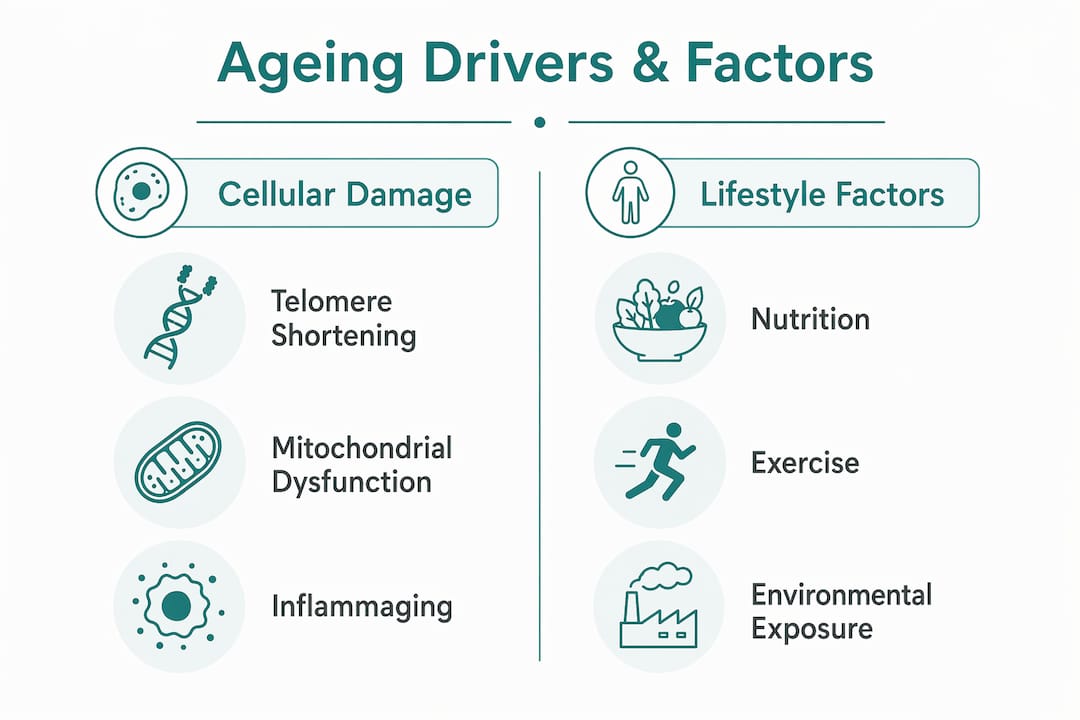
- Ageing results from the progressive accumulation of cellular and molecular damage, driven by mechanisms like telomere shortening and mitochondrial dysfunction.
- Lifestyle factors such as diet, sleep, and exercise influence biological age, which is modifiable despite genetic predispositions.
Ageing is defined as the progressive decline in biological function caused by the accumulation of cellular and molecular damage over time. The question of why we age sits at the intersection of genetics, evolutionary biology, and biochemistry, and the answer is not simple. Genetics, diet, exercise, and illness all contribute to how quickly and visibly this process unfolds. What science now confirms is that ageing is not a single event but a cascade of interacting processes, many of which begin far earlier than most people realise. Understanding those processes is the first step toward influencing them.
Why do we age? The cellular and molecular answer
Ageing begins at the cellular level, driven by damage that accumulates faster than the body can repair it. Several distinct biological mechanisms work together to produce the physical and cognitive changes we associate with getting older.
The most well-known driver is telomere shortening. Telomeres are protective caps at the ends of chromosomes, and they shorten with every cell division. When they become too short, cells stop dividing or die. This contributes directly to tissue decline and organ function loss. The process is gradual, which is why visible signs of ageing typically emerge in the 30s despite the underlying biology starting much earlier.

A second major driver is mitochondrial dysfunction. Mitochondria are the energy-producing structures inside cells, and their efficiency declines with age. The result is reduced cellular energy, increased production of damaging free radicals, and a growing inability to meet the metabolic demands of tissues. High-energy organs such as the brain, heart, and muscles are particularly vulnerable to this decline.
The hallmarks of ageing also include impaired autophagy (the cellular waste-clearance system), stem cell exhaustion, and chronic low-grade inflammation known as inflammaging. These processes do not operate in isolation. Each one amplifies the others, creating a feedback loop that accelerates systemic decline.
Key cellular mechanisms driving ageing:
- Telomere shortening: leads to cellular senescence and tissue degradation
- Mitochondrial dysfunction: reduces energy output and increases oxidative stress
- Impaired autophagy: allows cellular waste to accumulate and disrupt function
- Inflammaging: chronic low-grade inflammation that drives metabolic disease
- Stem cell exhaustion: limits the body’s capacity to regenerate damaged tissue
- Loss of intercellular communication: disrupts coordinated tissue repair
Pro Tip: Metabolism begins declining from around age 20, meaning the biological groundwork for visible ageing is laid long before most people start thinking about longevity. Understanding your cellular health foundations early gives you a longer window to act.
How does evolutionary theory explain why ageing occurs?
Biology can describe how ageing happens at the cellular level, but evolutionary theory explains why it happens at all. The field of evolutionary gerontology offers three principal models.
- Mutation accumulation: Natural selection cannot effectively remove harmful genetic mutations that only cause damage late in life, after an organism has already reproduced. These mutations accumulate across generations and express themselves as age-related decline.
- Antagonistic pleiotropy: Some genes are beneficial early in life (promoting growth and reproduction) but harmful later. Natural selection favours these genes because early reproductive success outweighs late-life costs.
- Disposable soma theory: The body allocates limited resources between reproduction and somatic (body) maintenance. Evolution favours investing in reproduction, leaving maintenance systems underfunded over time.
“Natural selection weakens with age, favouring reproduction investment over somatic maintenance.” — Molecular evolution of animal aging, EMBO Journal
This evolutionary framing has a striking implication: ageing is not a design flaw. It is the predictable outcome of selection pressures that prioritise passing on genes over preserving the individual body indefinitely. Species with high predation pressure, such as mice, age rapidly because investing in long-term maintenance offers little survival advantage. Species with low predation pressure, such as certain tortoises and bowhead whales, delay pro-ageing drivers and live for centuries. The biology of longevity is not fixed. It is shaped by evolutionary context, which means it is, at least in principle, open to influence.
What lifestyle and environmental factors affect how quickly we age?
Biological ageing is not purely determined by genetics or evolution. A substantial portion of how fast you age is modifiable. Biological age is malleable, with lifestyle accounting for roughly half of the rate at which ageing progresses. Two broad routes drive faster ageing: being in abundance mode (excess caloric intake and sedentary behaviour that triggers pro-growth signalling) and direct cellular damage from environmental exposures.
Factors that accelerate biological ageing include:
- UV radiation: damages DNA directly and degrades collagen in skin tissue
- Smoking: introduces oxidative stress and accelerates telomere shortening
- Chronic stress: triggers sustained cortisol release, which promotes inflammation and epigenetic changes
- Poor sleep: impairs cellular repair and waste clearance, particularly in the brain
- Sedentary behaviour: reduces mitochondrial efficiency and promotes systemic inflammation
- Obesity: drives metabolic dysregulation and amplifies inflammaging
On the other side of the equation, people of the same chronological age can look and function very differently depending on their lifestyle history. Regular physical activity, a diet rich in whole foods, consistent sleep, strong social connections, and continued mental engagement all reduce biological age relative to chronological age. Anxiety about ageing itself is worth noting: research indicates it may accelerate cellular ageing through epigenetic changes, making a calm, informed approach to the topic genuinely useful.
The distinction between chronological age (years lived) and biological age (how your cells and tissues are actually functioning) is one of the most practical concepts in ageing science. Your chronological age is fixed. Your biological age is not. Practical longevity strategies after 40 consistently show that targeted lifestyle changes can shift biological markers meaningfully, even later in life.
Pro Tip: Distinguishing between factors that increase cellular damage and those that support repair gives you a practical framework for daily decisions. Prioritise sleep and resistance exercise first. Both directly address mitochondrial function and cellular waste clearance, two of the most impactful ageing drivers.
What does recent science say about slowing or reversing ageing?
The most significant shift in ageing science over the past decade is the recognition that ageing is a plastic process. It is not a fixed biological countdown. Nutrient-signalling pathways are conserved longevity regulators across species, meaning the same molecular switches that extend lifespan in worms and flies also operate in humans.
| Intervention | Mechanism | Current evidence |
|---|---|---|
| Reduced insulin/IGF-1 signalling | Slows cellular ageing by shifting resources from growth to maintenance | Strong across multiple species; human data emerging |
| FOXO3A gene variants | Associated with human longevity; regulates stress resistance and repair | Observed in centenarian populations globally |
| NAD+ supplementation | Restores declining NAD+ levels linked to inflammaging and metabolic decline | Promising in preclinical studies; human trials ongoing |
| Caloric restriction | Activates repair pathways and reduces pro-growth signalling | Robust evidence in animals; human data supportive |
| Exercise | Improves mitochondrial biogenesis and reduces senescent cell burden | Strong human evidence across age groups |
The FOXO3A gene deserves particular attention. Variants of this gene appear consistently in studies of centenarians across different populations and ethnicities. FOXO3A regulates cellular stress responses, DNA repair, and the clearance of damaged proteins. Its activity is directly influenced by insulin signalling, which means diet and metabolic health are not peripheral concerns. They are central to how this longevity gene expresses itself.
NAD+ supplementation is generating significant research interest because NAD+ levels decline with age and are directly linked to mitochondrial function, inflammaging, and metabolic regulation. Restoring NAD+ shows promise in alleviating metabolic syndrome and slowing neurodegeneration in preclinical models. Human trials are ongoing, and the science is not yet settled, but the mechanistic rationale is sound. Exploring science-backed longevity nutrients that target these pathways is a reasonable step for anyone serious about healthy ageing.
Key takeaways
Ageing is driven by the accumulation of cellular and molecular damage across multiple interacting biological systems, and lifestyle choices directly influence how fast that damage accumulates.
| Point | Details |
|---|---|
| Ageing is multi-causal | No single mechanism explains ageing; telomere shortening, mitochondrial dysfunction, and inflammaging all interact. |
| Evolution explains the why | Natural selection favours reproduction over long-term body maintenance, making ageing an evolutionary trade-off. |
| Biological age is modifiable | Lifestyle accounts for roughly half of ageing rate; sleep, exercise, and diet are the highest-impact levers. |
| Nutrient signalling matters | Pathways involving insulin/IGF-1 and FOXO3A directly regulate how fast cells age and repair themselves. |
| NAD+ and cellular repair | Declining NAD+ levels drive inflammaging and metabolic decline; targeted supplementation shows early promise. |
Ageing is complex, but it is not beyond your influence
I have spent considerable time reading the ageing literature, and the single most important thing I have taken from it is this: most people dramatically underestimate how early the process begins and how much of it is within their control.
The conventional framing treats ageing as something that happens to you after a certain age. The science says otherwise. Metabolism begins declining in your 20s. Telomere shortening is continuous. Inflammaging builds quietly over decades. By the time the visible signs appear, the underlying biology has been accumulating for years.
What I find genuinely encouraging is the evidence on plasticity. The fact that FOXO3A activity responds to diet, that NAD+ levels can be partially restored, that biological age can diverge significantly from chronological age based on lifestyle choices. These are not marginal effects. They represent real leverage over a process that most people assume is entirely out of their hands.
The uncomfortable truth is that the biggest barriers are not scientific. They are behavioural. Consistent sleep, regular resistance training, a diet that avoids chronic caloric excess, and managing sustained stress. None of this is new information. What the ageing science adds is a precise mechanistic reason why each of these matters, which I find makes the motivation more durable than generic health advice.
It is never too late to shift your biological trajectory. The research is clear on that point.
— Jord
How Vivetus supports your cellular health

The science of ageing points consistently toward cellular health as the foundation of longevity. Vivetus offers a range of scientifically supported dietary supplements designed to address the biological drivers discussed in this article, including NAD+ metabolism, mitochondrial function, and inflammation management. Each product in the Vivetus range is selected for its alignment with current ageing research, giving you a practical way to support your body at the cellular level. Free shipping applies to orders over €50, making it straightforward to start. Explore the full Vivetus supplement range and find products matched to your longevity goals.
FAQ
Why do we age biologically?
Ageing occurs because of the progressive accumulation of cellular and molecular damage, including telomere shortening, mitochondrial dysfunction, and chronic inflammation. No single mechanism is solely responsible; multiple interacting processes drive systemic decline over time.
Does genetics determine how fast we age?
Genetics contributes to ageing rate, but lifestyle accounts for roughly half of how quickly biological ageing progresses. Factors such as diet, exercise, sleep quality, and stress management all directly influence biological age independent of genetic inheritance.
What is the difference between biological age and chronological age?
Chronological age is simply the number of years you have lived. Biological age reflects how your cells and tissues are actually functioning, and it can be significantly younger or older than your chronological age depending on lifestyle and health history.
Can ageing be slowed?
Current research confirms that ageing is a plastic process, not a fixed biological countdown. Interventions targeting nutrient-signalling pathways, NAD+ levels, and chronic inflammation show measurable effects on biological ageing markers in both animal and early human studies.
What is inflammaging?
Inflammaging is the term for the chronic low-grade inflammation that both results from and accelerates the ageing process. It is linked to declining NAD+ levels, metabolic dysregulation, and increased risk of age-related diseases including neurodegeneration and cardiovascular decline.