

Astragalus and TA‑65: Human Trials on Telomere Supplements
Some telomere supplements have measurably lengthened telomeres in small, controlled human trials, most notably Astragalus extracts and TA-65, but the effects are modest and the research base is thin. Realistic expectations matter more than marketing: lifestyle factors still carry more weight than any capsule. For a targeted approach, ingredients like Astragalus, NMN, and TMG have the clearest human data behind them, and products such as those in the 🔬VitaalPlus bundel reflect that evidence-first thinking rather than a single miracle molecule.
TL;DR:
- Human trial evidence for telomere lengthening is limited, with some positive results from Astragalus-based supplements and TA-65 over six to twelve months.
- Telomerase activators like Astragalus extracts show the most direct effects, but higher doses do not necessarily produce better results, and long-term safety remains uncertain.
- NAD+ precursors such as NMN indirectly support telomere health through DNA repair mechanisms, but human data is still sparse, and effects may not translate from animal studies.
- Most supplements claiming telomere benefits lack transparency in ingredient doses and rely heavily on preclinical data rather than randomized human trials.
- Cost-effective, evidence-based choices favor products with proven doses, clear ingredient sourcing, third-party testing, and realistic trial durations.
Table of Contents
- Do human trials support telomere supplements?
- How might supplements affect telomerase, NAD+ and oxidative damage?
- Are telomere supplements safe, and what should you expect?
- How to choose a telomere supplement that fits the evidence
- What quality standards should telomere supplements meet?
- Marketing claims versus what trials actually found
- Single ingredients versus combination formulas: which wins?
- What do telomere supplements cost, and are they worth it?
- A candid editorial note on the evidence
- Which Vivetus products match the evidence covered here
- Key studies and reviews to read next
- Sources
- FAQ
Do human trials support telomere supplements?
The honest answer is: partially. A handful of randomised, placebo-controlled trials have found measurable telomere changes, which is more than can be said for most supplement categories. But “measurable” and “meaningful” are not the same thing, and the sample sizes involved are small enough that a single well-designed follow-up study could shift the picture considerably.
The most cited positive result comes from a 2024 randomised, double-blind, placebo-controlled study of an Astragalus-based nutritional supplement. Over six months, middle-aged volunteers (mean age around 56) taking the supplement showed statistically significant increases in both median and short telomere length compared with placebo. Six months is a reasonably short window for a biological marker that typically shifts slowly, which makes the result worth taking seriously, even if it needs repeating in a larger cohort.
TA-65, a compound derived from Astragalus and marketed specifically as a telomerase activator, has the longest track record. A 1-year randomised, double-blind study in older, CMV-positive adults aged 53 to 87 found that the low dose (250 units) increased median telomere length by roughly 530 base pairs, while the placebo group actually lost around 290 base pairs over the same period. Interestingly, the low dose outperformed higher doses in this trial, a detail that matters more than it might first appear.
- Astragalus-based supplement: significant telomere gains after six months in middle-aged adults
- TA-65 (low dose): telomere length increased over 12 months versus placebo loss
- Mylife/Mylife100® blend: telomere gains reported in a small 32-person trial over 8 to 16 weeks
- Pomegranate extract: no telomere change after 12 weeks despite raised IGF-1
Statistic to note: in the TA-65 trial, the placebo group lost a notable amount of telomere length over the study period while the low-dose group gained length, illustrating the natural decline these trials measure against as well as the supplement effect.
Not every trial lands positive. A 2025 randomised trial of pomegranate extract found it raised IGF-1 levels in older adults after 12 weeks but produced no change in telomere length at all. That gap between “biologically active” and “telomere-active” is a recurring theme, and it is one reason single-ingredient antioxidant claims deserve more scrutiny than they usually get.
How might supplements affect telomerase, NAD+ and oxidative damage?
Three distinct mechanisms get lumped together under “telomere support,” and they are not interchangeable.
Telomerase activators work most directly. Astragalus extracts and the related compound cycloastragenol appear to stimulate the enzyme telomerase itself, which rebuilds the protective caps on chromosome ends. This is the mechanism behind both the Astragalus RCT and TA-65 results above, and it is the only pathway with repeated human trial support for actual telomere lengthening rather than just slower shortening.
NAD+ precursors work indirectly. Compounds like NMN raise intracellular NAD+, which fuels sirtuins and PARP enzymes involved in DNA repair and cellular maintenance. A clinical trial using 300 mg of NMN daily confirmed this raises NAD+ safely over 60 days. Mechanistic research also links NAD+ dysregulation to telomere dysfunction in cell and animal models, where restoring NAD+ balance reduced telomeric DNA damage. The catch: a recent review of NAD+ precursor evidence in human ageing concludes that human data remains sparse, and effects seen in animal tissue do not always translate cleanly to people. Our own explainer on NMN dosing for adults over 50 goes into more detail on how this pathway is thought to work.
Antioxidant blends take a third route, protecting existing telomeres from oxidative shortening rather than actively lengthening them. The Mylife100® trial fits here, alongside general vitamin and mineral approaches.
- Telomerase activators: direct enzyme stimulation, strongest human evidence so far
- NAD+ precursors: indirect support via sirtuins and DNA repair pathways
- Antioxidant blends: damage prevention rather than active lengthening
- Combination approaches: biologically plausible, but not yet proven in people
Pro Tip: Pairing an NAD+ precursor with a methylation-support nutrient like TMG is a common stacking strategy, since NMN metabolism increases demand for methyl groups. Our TMG and NMN guide explains why the two are often taken together.
Some researchers have floated combining NAD+ precursors with CD38 inhibitors or flavonoids such as apigenin, since CD38 is an enzyme that consumes NAD+. It is a sound theory on paper, but it remains exactly that: a theory awaiting a proper human trial.
Are telomere supplements safe, and what should you expect?
The TA-65 trial’s dose-response pattern is the detail most marketing material glosses over: the low dose (250 units) outperformed higher doses, suggesting a bell-shaped response rather than “more is better.” That alone should make anyone wary of products pushing maximum-strength telomerase activators.
There is also a genuine, unresolved theoretical question hanging over telomerase activation. Since telomerase also plays a role in unchecked cell proliferation, some scientists have raised a cautious concern about long-term activation and cancer risk, though this remains debated rather than settled in the research. Both very short and unusually long telomeres have been linked to poor health outcomes, so “longer is always better” is not a safe assumption for anyone to make.
Practically, this means:
- Trials showing telomere change have run from 8 weeks to 12 months, and effects are typically small in magnitude
- Most studies involve fewer than 100 participants, which limits how confidently results generalise
- People with a personal or family history of cancer should discuss telomerase activators and NAD+ precursors with their doctor before starting, and keep any supplement documented in their medical records
- A large UK Biobank analysis of over 130,000 people found no overall positive link between general supplement intake and telomere length at population scale, a useful reality check against sweeping claims
How to choose a telomere supplement that fits the evidence
Given how uneven the evidence is, a practical checklist beats a leap of faith:
- Look for an ingredient with at least one randomised, placebo-controlled human trial behind it, not just cell-culture data.
- Match the dose to what was actually used in that trial, not a marketing-friendly “extra strength” version.
- Check the label states exact ingredient amounts rather than hiding behind a proprietary blend.
- Favour brands that test for purity and disclose sourcing.
- Confirm the trial duration was realistic. Anything promising results within days is not backed by the research covered above.
- Check subscription and return terms before committing to ongoing purchases.
Your choice of ingredient should follow the evidence, not the other way round. If you want a telomerase-activation angle, Astragalus-type ingredients have the clearest human trial record. If cellular energy and NAD+ support is the priority, Vivetus® NMN products state their ingredient content transparently, which lets you match dose to what trials actually used. For methylation support alongside an NAD+ precursor, TMG is the pairing worth reading up on.
- Start with one product or bundle for a defined trial period rather than stacking five ingredients at once.
- Check for interactions with any existing medication, particularly blood thinners or cancer treatments.
- Consult a clinician first if you have an active illness, are pregnant, or take prescription medication regularly.
What quality standards should telomere supplements meet?
Rather than wading into legal frameworks that vary by country, the more useful question for a buyer is what quality markers actually separate a credible product from a marketing exercise. Third-party purity testing, clear per-capsule dosing, and ingredient sourcing disclosure are the practical signals worth checking on any label, telomere-focused or otherwise.
Proprietary blends are the biggest red flag in this category specifically. When a label lists a “telomere support complex” without individual ingredient amounts, there is no way to compare it against the doses used in actual trials like the Astragalus study or TA-65 research. That is not a legal issue, it is a transparency one, and it is entirely within a buyer’s control to check before purchasing.
Most commercial telomere products lean on preclinical or cell-culture data rather than the kind of randomised human trials covered earlier, and proprietary formulations often make it difficult to know which ingredient, if any, is doing the work. A supplement built around a single, named, dosed ingredient with published human data is easier to evaluate honestly than a ten-ingredient blend with no breakdown.
Marketing claims versus what trials actually found
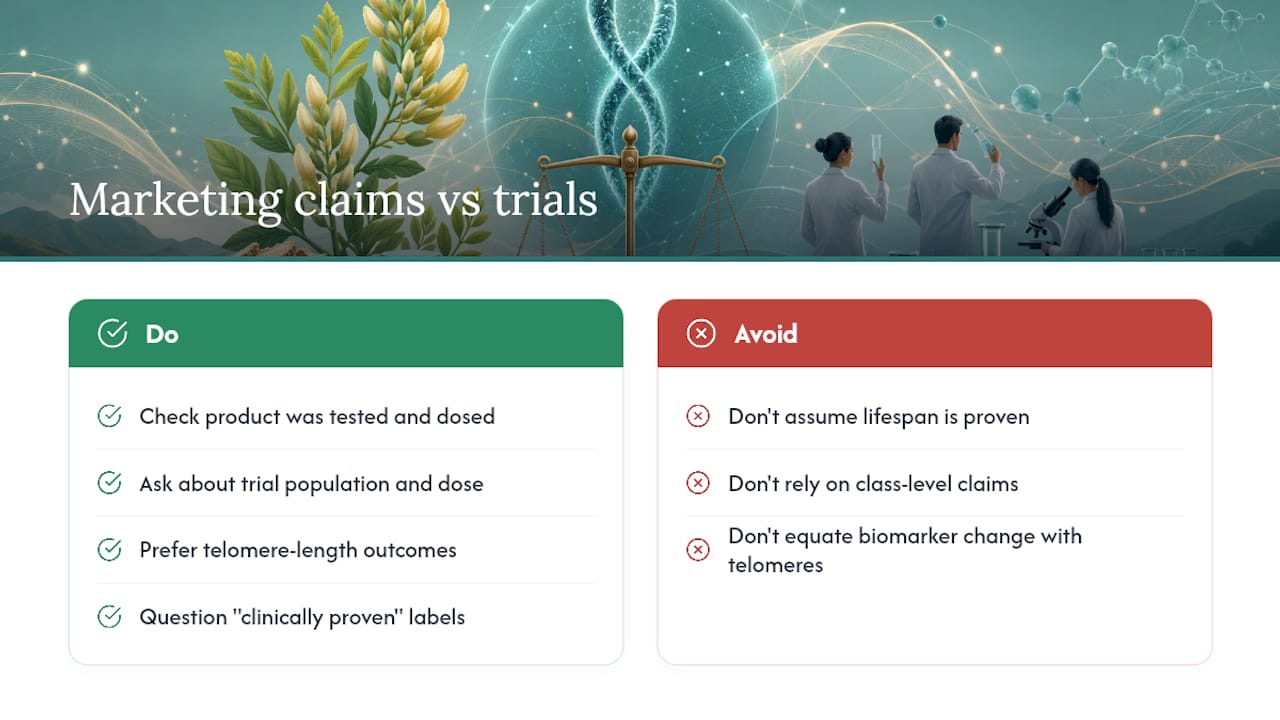
“Reverses ageing” and “adds years to your life” are the two claims you will see most often on telomere supplement packaging, and neither is supported by the trials discussed above. What the Astragalus and TA-65 studies actually showed was a measurable change in telomere length over months, in specific populations, at specific doses. That is a genuinely interesting result. It is not the same as proving longer lifespan or reversed biological age, since none of these trials tracked participants long enough to measure that outcome.
Another common claim worth questioning: “clinically proven to activate telomerase.” Cycloastragenol and Astragalus extracts do have trial support for telomerase activity and telomere length change, but “clinically proven” language often gets borrowed by products with no trial data of their own, simply because they share an ingredient category. Always ask whether the specific product, at its specific dose, was tested, not whether the ingredient class has ever appeared in a study anywhere.
The pomegranate trial result is a useful gut check here. It raised a genuine biomarker (IGF-1) and still failed to move telomere length after 12 weeks, which is a reminder that a supplement doing something measurable in the body is not the same as it doing the specific thing being marketed.
Single ingredients versus combination formulas: which wins?
Single-ingredient products win on clarity. When Astragalus extract or NMN is the only active ingredient at a stated dose, you can compare it directly against the trial that tested it, which is exactly the comparison this article has walked through above.
Combination formulas win on biological plausibility, at least on paper. Pairing an NAD+ precursor with a flavonoid or methylation nutrient makes mechanistic sense, since raising NAD+ increases downstream demand for methyl groups. But plausibility is not proof, and no combination formula reviewed in the trials above has been tested head-to-head against its individual ingredients to show the combination outperforms either alone.
The practical takeaway sits somewhere in the middle. A tightly focused product built around one well-dosed, trial-backed ingredient is easiest to evaluate and easiest to attribute results to. A bundle that pairs complementary, individually dosed ingredients, such as an NMN product alongside TMG for methylation support, keeps that same transparency while addressing more than one pathway. What loses on both counts is a blend that hides individual amounts behind a single “complex” label, because at that point you are trusting marketing rather than evidence.
What do telomere supplements cost, and are they worth it?
Prices across the telomere and NAD+ supplement category vary widely, from budget single-ingredient capsules to premium bundles combining several trial-referenced compounds. Cost-effectiveness depends less on the price tag itself and more on whether the dose and ingredient match what was actually used in a human trial.
A cheap product at an underdosed level is poor value even at a low price, since it will not replicate the six-month Astragalus result or the TA-65 findings covered earlier. Conversely, an expensive proprietary blend with hidden amounts is difficult to judge as value at all, because there is no dose to compare against the evidence. The more useful cost question is: does this specific product, at this specific dose, resemble what was tested? Vivetus lists current pricing directly on each product page, which at least lets you do that comparison honestly before buying.
Subscription options, where available, tend to improve cost-effectiveness for anyone planning to trial a supplement for the eight weeks to twelve months that the trials above suggest is a realistic window for seeing any change at all. A single-month trial rarely tells you much, given how slowly telomere length shifts even under the most positive study conditions.
A candid editorial note on the evidence
Publishing an evidence-first guide on telomere supplements means sitting with some discomfort. The trials are real, the Astragalus and TA-65 results are genuinely interesting, and yet the honest summary is still “promising, not proven.” Vivetus publishes this kind of guidance because health-conscious readers deserve the caveats alongside the excitement, not a sanitised version of either. Where new large-scale trials emerge, particularly anything that follows TA-65’s dose-response pattern further, this article will be updated to reflect it. Lifestyle measures, covered in our guide to healthy ageing habits, remain the more reliable lever regardless of which supplement you choose.
— Jord
Which Vivetus products match the evidence covered here
Some retailers offer trial-referenced ingredients without proprietary blends that hide individual dosing. Every product line states its ingredient focus plainly, which is precisely the transparency this article has argued matters more than any single superlative claim.
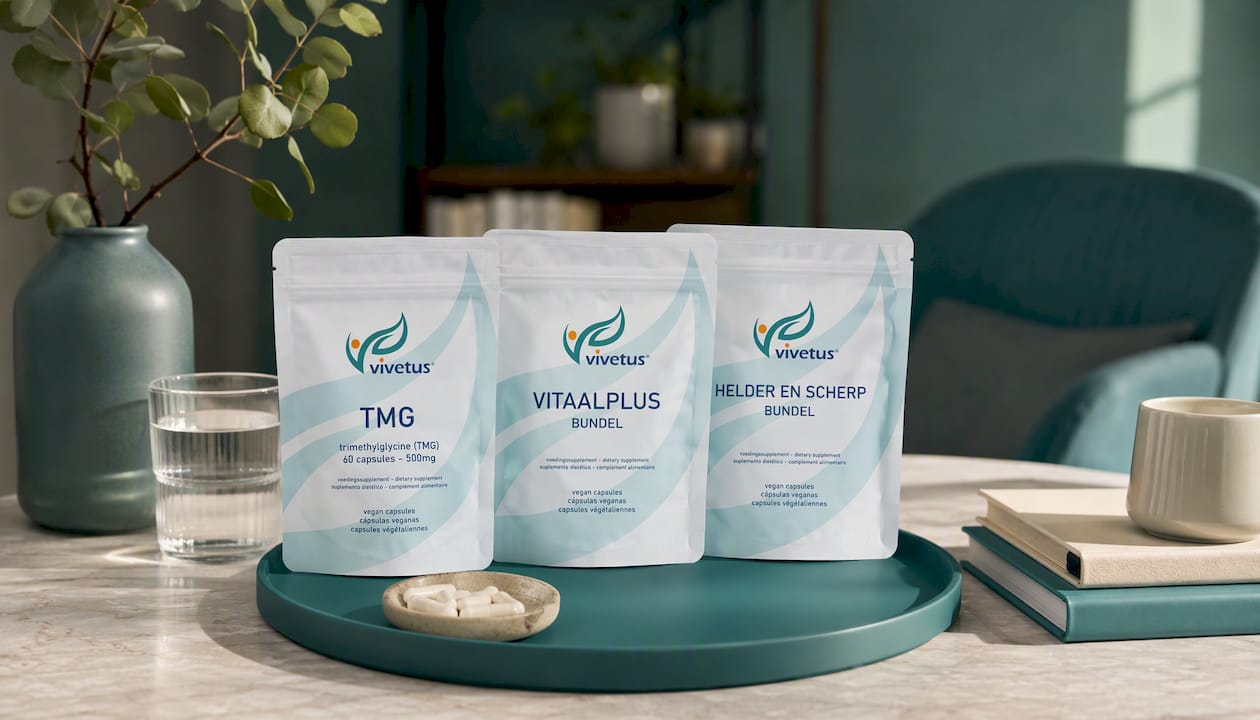
If the Astragalus and TA-65 evidence appeals to you as a starting point, the 🔬VitaalPlus bundel brings together several longevity-focused ingredients in one transparent formulation, assembled in the Netherlands. Anyone more interested in cognitive and cellular energy support alongside NAD+ pathways might look at the Helder en Scherp bundel instead. For the NAD+ precursor route discussed in the mechanism section, Vivetus® NMN is the dedicated collection, and pairing it with Vivetus® TMG addresses the methylation demand that NMN supplementation creates. Readers drawn to antioxidant support can also explore Vivetus® Resveratrol, Vivetus® Quercetin, Vivetus® Fisetin, and Vivetus® Pterostilbene, while Vivetus® Apigenin fits the flavonoid pairing strategy mentioned earlier. Some formulations are vegan and GMO-free, with free shipping on orders over a set amount. Start with a single bundle for a defined trial period, check the exact dose against what interests you from the trials above, and speak with your doctor first if you have an active illness or take regular medication.
Key studies and reviews to read next
- Astragalus supplement RCT on telomere length
- TA-65 1-year randomised study
- Mylife100® telomere length trial
- NMN and NAD+ clinical trial
- UK Biobank micronutrient and telomere analysis
This article is general information, not a substitute for advice from a qualified doctor. Consult a qualified healthcare professional about your own circumstances before acting on anything here.
Sources
- A natural Astragalus‑based nutritional supplement lengthens telomeres in a middle‑aged population: randomized, double‑blind, placebo‑controlled study
- TA‑65 randomized, double blind, placebo controlled study — telomere length changes over 1 year
- Randomized trial of Mylife/Mylife100® dietary supplement showing telomere length increases
- Clinical NMN trial showing increased NAD+ levels at 300 mg daily
- Micronutrient intake and telomere length: findings from the UK Biobank
FAQ
Do telomere supplements actually work?
Some do show measurable effects in trials, most notably Astragalus-based supplements and TA-65, which both produced significant telomere length increases over several months. The effects are real but modest, and not every ingredient category has this level of support.
How long before I would notice a difference?
Trials measuring telomere change have run from 8 weeks to 12 months, and the TA-65 study needed a full year to show its clearest result. Nothing in the current research suggests visible or felt changes on a shorter timescale.
Is there a cancer risk from telomerase-activating supplements?
This remains a debated, theoretical concern rather than a settled finding, since telomerase also supports cell proliferation. Anyone with a personal or family history of cancer should discuss telomerase activators with their doctor before use.
Is NMN the same thing as a telomere supplement?
Not exactly. NMN supports NAD+ levels and DNA repair pathways that may indirectly help maintain telomeres, but it works through a different mechanism than direct telomerase activators like Astragalus extracts. Vivetus® NMN is positioned for cellular energy and healthy ageing support rather than as a telomerase activator specifically.
How much do Vivetus telomere-related bundles cost?
Current pricing for the 🔬VitaalPlus bundel and other Vivetus products is listed directly on each product page. Orders over €50 qualify for free shipping.