

The role of micronutrients in health and longevity
TL;DR:
- Micronutrients are essential vitamins and minerals vital for energy, immunity, and tissue repair. Deficiencies develop quietly and can accelerate aging, frailty, and disease. Proper intake, through diet and targeted supplementation, supports healthy aging and functional independence.
Micronutrients are the vitamins and minerals your body requires in small amounts to sustain metabolism, immune function, and tissue maintenance. Without them, every biological process from energy production to cellular repair slows down or fails. The role of micronutrients extends far beyond preventing deficiency diseases. Research published in 2026 confirms that adequate intake of specific vitamins and minerals directly influences how well you age, how resilient your immune system remains, and how long you stay functionally independent. For health-conscious individuals and caregivers supporting older adults, understanding which micronutrients matter most is one of the most practical steps towards better long-term health.
What are the main types of micronutrients and their roles in the body?
Micronutrients divide into two broad categories: vitamins and minerals. Vitamins split further into fat-soluble types (A, D, E, and K) and water-soluble types (the B-complex group and vitamin C). Minerals include macrominerals such as calcium, magnesium, and potassium, as well as trace minerals such as zinc, iron, and selenium. Each group behaves differently in the body, and understanding those differences helps explain why deficiencies are so common.

Fat-soluble vitamins accumulate in body fat and the liver, which means they are stored between meals but can also build up to excess. Water-soluble vitamins are not stored in meaningful quantities, so the body needs a regular supply from food. Trace minerals are required in tiny amounts, yet their absence causes measurable harm. Zinc, for example, is central to immune signalling, wound healing, and protein synthesis.
The table below summarises the key micronutrient groups and their primary functions.
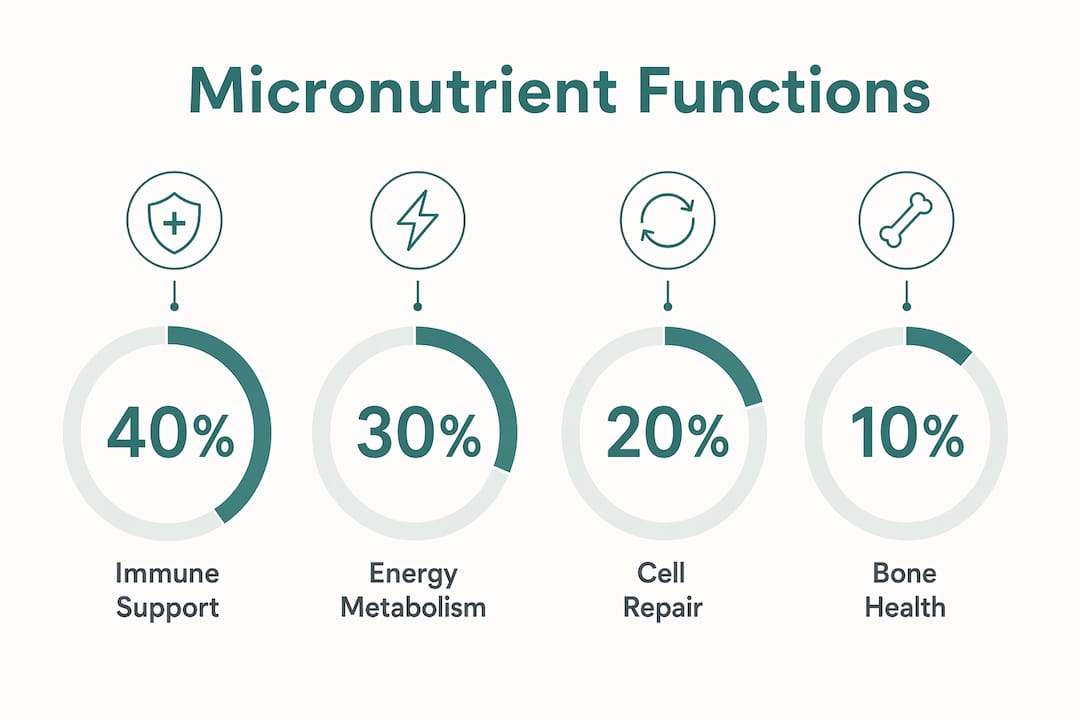
| Micronutrient group | Key examples | Primary function |
|---|---|---|
| Fat-soluble vitamins | A, D, E, K | Immune regulation, bone health, antioxidant defence |
| Water-soluble vitamins | B-complex, C | Energy metabolism, red blood cell production, collagen synthesis |
| Macrominerals | Calcium, magnesium, potassium | Bone density, nerve signalling, muscle contraction |
| Trace minerals | Zinc, iron, selenium | Enzyme activity, oxygen transport, thyroid function |
Age changes how well the body absorbs micronutrients. Absorption declines often start around age 50, affecting nutrients such as vitamin B12, calcium, and vitamin D in particular. This is not simply a matter of eating less. Reduced stomach acid, slower gut motility, and changes in kidney function all reduce how much the body actually extracts from food.
Pro Tip: Fat-soluble vitamins (A, D, E, K) are best absorbed when eaten alongside a source of dietary fat, such as olive oil, avocado, or oily fish. A dry salad with no dressing delivers far less vitamin K than the same salad dressed with extra-virgin olive oil.
How do micronutrient deficiencies affect health and ageing?
Deficiencies rarely announce themselves with dramatic symptoms. They build quietly over months or years, eroding energy, immune resilience, and cognitive sharpness before any clinical diagnosis is made. This slow onset is precisely what makes them dangerous for older adults.
The consequences of sustained deficiency are well documented. Vitamin D insufficiency weakens bones and impairs immune signalling. Low zinc reduces the body’s ability to mount an effective response to infection. Inadequate B12 causes neurological damage that can be mistaken for dementia. Calcium deficiency accelerates bone loss, increasing fracture risk. These are not rare edge cases. They are common outcomes in ageing populations across Europe.
The scale of the problem is striking. 67.9% of institutionalised older adults are malnourished or at nutritional risk, compared with 28% of those living in the community. Institutionalised older adults show vitamin D deficiency rates of 70–94% and zinc deficiency rates of 50–66%. These figures reflect not just poor diet but also malabsorption, polypharmacy, and reduced sun exposure.
A further dimension is what researchers call “inflammaging,” the chronic low-grade inflammation that accumulates with age. Micronutrients A, B-complex, C, D, E, and K all play a role in modulating this inflammatory state, alongside gut microbiome health. Persistent inflammaging is linked to frailty, cardiovascular disease, and cognitive decline. Correcting micronutrient gaps does not eliminate ageing, but it meaningfully slows its most damaging effects.
There is also a broader context worth noting. In older Europeans, a 17-year gap exists between average life expectancy (around 81 years) and healthy life expectancy (around 64 years). Micronutrient deficiencies contribute directly to that gap by worsening frailty and reducing functional independence. Caregivers supporting older relatives should treat nutritional screening as a routine part of health management, not an afterthought.
Which micronutrients are vital for healthy ageing and vitality?
The Linus Pauling Institute identifies ten micronutrients as most critical for healthy ageing: calcium, magnesium, potassium, zinc, and vitamins B6, B12, C, D, E, and K. Each one addresses a specific vulnerability that becomes more pronounced with age.
- Calcium maintains bone density and supports nerve transmission. Absorption falls significantly after age 50, making dietary sources and targeted supplementation both relevant.
- Magnesium supports over 300 enzymatic reactions, including ATP production and blood glucose regulation. Most older adults consume less than the recommended amount.
- Potassium regulates blood pressure and muscle function. Low intake is associated with increased cardiovascular risk.
- Zinc drives immune cell production, DNA repair, and wound healing. Deficiency is among the most prevalent in institutionalised older adults.
- Vitamin B6 supports neurotransmitter synthesis and immune function. Deficiency is linked to depression and cognitive impairment.
- Vitamin B12 is required for myelin production and red blood cell formation. Absorption depends on intrinsic factor, which declines with age and certain medications.
- Vitamin C acts as a direct antioxidant and supports collagen synthesis. It also enhances iron absorption from plant-based foods.
- Vitamin D regulates calcium absorption, immune function, and muscle strength. Supplementation is widely recommended for older adults, particularly in northern climates.
- Vitamin E protects cell membranes from oxidative damage. Vitamin E showed the strongest cellular immunity effects in a meta-analysis of 665 older adults.
- Vitamin K is required for blood clotting and bone mineralisation. K2 in particular supports calcium deposition in bone rather than arterial walls.
Beyond this list, vitamin D and omega-3 fatty acids deserve special attention. The European DO-HEALTH and US VITAL studies found that combining vitamin D, omega-3 fatty acids, and exercise reduces cancer risk and frailty while potentially slowing biological ageing. The synergy between these three interventions is stronger than any single one alone. You can read more about omega-3 and ageing and why the combination matters for long-term vitality.
Pro Tip: Vitamins C and E work synergistically as antioxidants. Vitamin C regenerates oxidised vitamin E, so getting both from food or supplements together is more effective than either alone.
How can you ensure adequate micronutrient intake as you age?
A diverse whole-food diet remains the most reliable foundation for micronutrient sufficiency. Leafy greens, legumes, oily fish, eggs, dairy, nuts, and seeds each provide distinct micronutrient profiles that processed foods cannot replicate. Ultra-processed foods, even when fortified, deliver nutrients in forms that are often less bioavailable and come packaged with additives that may interfere with absorption.
That said, diet alone is not always sufficient for older adults. Vitamin B12 is a clear example. Its absorption requires intact stomach acid and intrinsic factor, both of which decline with age. Many older adults taking proton pump inhibitors or metformin are at particular risk. Supplementation in these cases is not optional. It is necessary. Vitamin D is similar: dietary sources are limited, and sun exposure decreases with age and reduced outdoor activity. A balanced diet for older adults provides the framework, but targeted supplements fill the gaps that food cannot.
Nutrient interactions are also worth understanding. High-dose zinc supplementation inhibits copper absorption, and calcium supplements can reduce magnesium and iron absorption when taken with meals. Taking supplements without understanding these interactions can create new deficiencies while correcting others. Supplementation should be individualised, not generic.
Routine nutritional screening matters more than most people realise. Blood tests do not fully represent intracellular or tissue micronutrient status, so a normal result does not guarantee sufficiency at the cellular level. Whole-food intake remains the primary measure of nutritional health. Diagnostics inform the picture but do not replace it. For caregivers, arranging periodic nutritional assessments for older relatives is one of the most practical steps available.
- Prioritise variety: aim for at least 30 different plant foods per week to support both micronutrient intake and gut microbiome diversity.
- Pair nutrients correctly: eat iron-rich plant foods with vitamin C sources to improve absorption.
- Review medications: certain drugs, including antacids, diuretics, and antibiotics, deplete specific micronutrients over time.
- Do not rely on fortified foods alone: the bioavailability of added nutrients is often lower than in whole-food sources.
- Seek professional guidance before starting high-dose supplements, particularly for fat-soluble vitamins that accumulate in tissue.
Key takeaways
Micronutrients regulate metabolism, immune function, and cellular repair, and their deficiency accelerates the functional decline associated with ageing.
| Point | Details |
|---|---|
| Deficiency is widespread | 67.9% of institutionalised older adults are malnourished or at nutritional risk. |
| Ten micronutrients matter most | Calcium, magnesium, potassium, zinc, and vitamins B6, B12, C, D, E, and K are the priority list for healthy ageing. |
| Synergy amplifies benefit | Combining vitamin D, omega-3 fatty acids, and exercise reduces cancer risk and frailty more than any single intervention. |
| Blood tests have limits | Standard blood panels do not measure intracellular stores; whole-food intake is the primary indicator of sufficiency. |
| Supplementation needs care | High-dose zinc inhibits copper; calcium supplements reduce magnesium and iron absorption when taken with food. |
Why micronutrients deserve more attention than they get
I have spent years reading research on healthy ageing, and the pattern that strikes me most is how consistently micronutrients are underestimated. Most people associate supplements with either elite athletes or frail nursing home residents. The reality is that the gap between adequate and inadequate intake is far smaller than most people assume, and the consequences accumulate long before any test flags a problem.
What the research from 2026 makes clear is that this is not just about preventing deficiency. It is about maintaining the biological conditions for independence. The DO-HEALTH and VITAL studies are particularly compelling because they show that combining vitamin D, omega-3 fatty acids, and regular exercise produces effects that no single intervention achieves alone. That kind of evidence should change how caregivers and health-conscious individuals think about supplementation. It is not a fallback for poor diet. It is a targeted strategy.
The part of this that I think gets least attention is the gut microbiome connection. Micronutrients modulate inflammaging partly through their effect on gut bacteria. If your gut health is poor, even a good diet may not deliver adequate micronutrient status at the cellular level. That is why I think the most effective approach combines dietary variety, targeted supplementation where needed, and consistent physical activity. No single pillar is enough on its own. You can read more about essential minerals for longevity to build a clearer picture of where to focus first.
— Jord
Supporting your micronutrient needs with Vivetus
Dietary changes take time to produce results, and for older adults or those with absorption challenges, food alone may not close every gap.
Vivetus offers an Energy & Vitality bundel designed to complement a whole-food diet with the micronutrients most relevant to active, healthy ageing. The bundle brings together nutrients that research identifies as central to immune resilience, energy metabolism, and cellular protection. It is a practical option for health-conscious individuals and caregivers who want a structured approach to supplementation without navigating dozens of individual products. Free shipping applies on orders over €50, and the Vivetus account system makes reordering straightforward.
FAQ
What is the role of micronutrients in the body?
Micronutrients are vitamins and minerals that act as cofactors for enzymatic reactions, support immune function, and maintain cellular repair processes. Without adequate intake, metabolism, energy production, and tissue maintenance all decline.
Which micronutrient deficiencies are most common in older adults?
Vitamin D, zinc, vitamin B12, and calcium are the most prevalent deficiencies in older adults. Institutionalised older adults show vitamin D deficiency rates of 70–94% and zinc deficiency rates of 50–66%.
Can supplements replace a healthy diet for micronutrient intake?
Supplements address specific gaps but do not replicate the full nutritional profile of whole foods. Whole-food diets provide micronutrients in more bioavailable forms alongside fibre and phytonutrients that supplements cannot deliver.
How do micronutrients support vitality and healthy ageing?
Micronutrients regulate mitochondrial function, modulate chronic inflammation, and support immune resilience. Combined intake of vitamin D, omega-3 fatty acids, and regular exercise has been shown to reduce frailty and cancer risk in clinical studies.
Is it safe to take multiple micronutrient supplements together?
Not all combinations are safe at high doses. High-dose zinc inhibits copper absorption, and calcium supplements can reduce magnesium and iron absorption. Supplementation should be individualised and reviewed by a health professional.