

What is functional nutrition: a complete 2026 guide
TL;DR:
- Functional nutrition is a systems-based, patient-centered approach focusing on the root causes of health issues using food and lifestyle changes. It relies on advanced assessment tools and personalized plans considering genetics, environment, and biochemistry to improve complex conditions. Supplements are used as targeted support, working alongside conventional medicine to promote long-term well-being.
Functional nutrition is defined as a systems-based, patient-centred approach that uses food, nutrients, and lifestyle changes to address the root causes of health imbalances rather than isolated symptoms. Recognised by the Institute for Functional Medicine (IFM), this approach treats the body as a network of interconnected systems rather than a collection of separate parts. Where conventional dietary advice focuses on calories and nutrient ratios, functional nutrition asks why those imbalances exist in the first place. For health-conscious readers who want to go beyond generic dietary guidelines, understanding this approach offers a genuinely different framework for long-term well-being.
What is functional nutrition and how does it work?
Functional nutrition works by identifying the specific biochemical, environmental, and lifestyle factors that drive an individual’s health concerns. Rather than prescribing a one-size-fits-all diet, it maps how digestion, immune function, hormonal output, and the nervous system interact with each other. A disruption in one system, such as poor gut health, can cascade into fatigue, mood changes, and hormonal irregularities.
The scientific foundation rests on systems biology, the study of how biological components interact as a whole. This contrasts sharply with reductionist models that treat each symptom in isolation. A 2026 randomised controlled trial found that an 8-week functional nutrition protocol enriched with omega-3s, magnesium, B vitamins, and antioxidants significantly improved cognitive function and reduced stress in young adults. Effect sizes ranged from Cohen’s d 0.68 to 0.82 compared to a control group. That is a clinically meaningful result, not a marginal one.
“Functional nutrition prioritises the unique interplay of genetics, environment, and lifestyle. No two people share the same biochemical context, and no single dietary plan works for everyone.”
The concept of bio-individuality sits at the heart of this approach. Two people eating identical diets can experience entirely different health outcomes because their genetics, gut microbiomes, stress histories, and sleep patterns differ. Functional nutrition accounts for this variation by design.
Pro Tip: If you are new to this approach, start by tracking not just what you eat but how you feel two hours after each meal. Patterns in energy, digestion, and mood are early signals that functional nutritionists use to build a clinical picture.

How does functional nutrition differ from traditional nutrition?
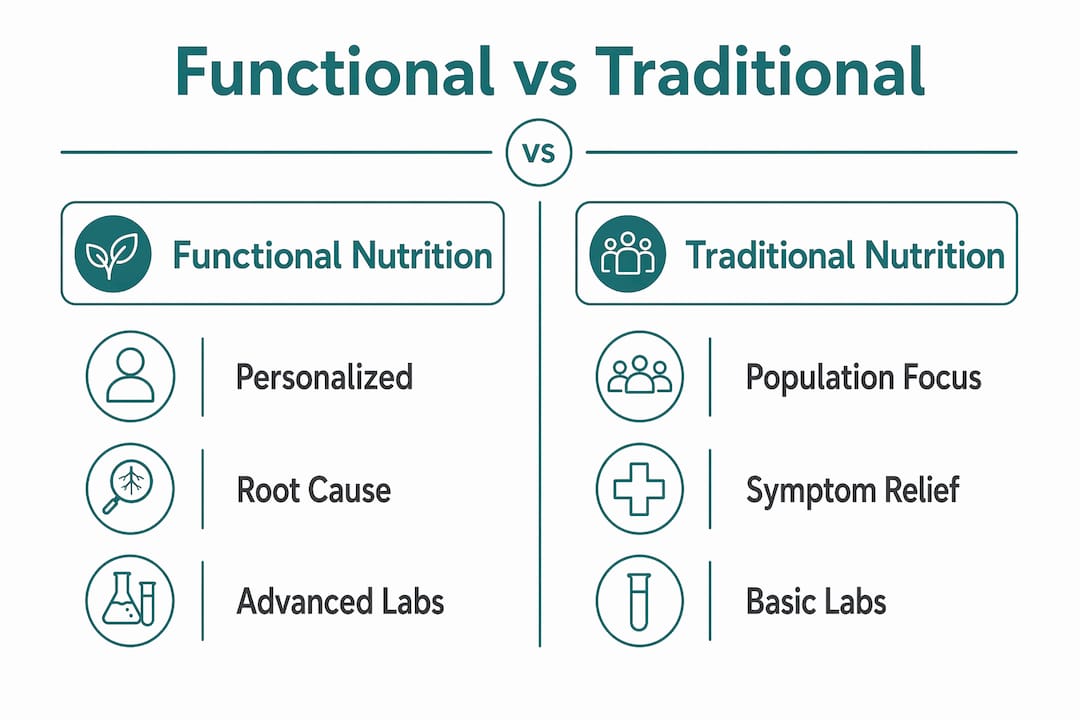
Traditional nutrition and functional nutrition share a common goal, better health through diet, but they differ significantly in method, depth, and philosophy.
Traditional dietary guidance focuses on macronutrient balance, caloric intake, and adherence to population-level guidelines such as the Eatwell Guide. It is effective for general health promotion but rarely addresses the underlying biochemistry of a specific individual. Functional nutrition, by contrast, uses advanced diagnostic tools including gut microbiome analysis, comprehensive nutrient panels, and hormone mapping to identify subclinical imbalances that standard GP tests would miss.
The assessment process itself is markedly different. A conventional dietitian appointment typically lasts 20–30 minutes and centres on dietary recall. A functional nutrition consultation runs 60–90 minutes and covers sleep quality, stress history, trauma, toxin exposure, and environmental factors, all of which influence how the body metabolises nutrients.
Here is a direct comparison of the two approaches:
| Feature | Traditional nutrition | Functional nutrition |
|---|---|---|
| Primary focus | Caloric balance and nutrient ratios | Root causes of biochemical imbalance |
| Assessment tools | Dietary recall, BMI, standard blood tests | Personal health timeline, advanced lab panels |
| Consultation length | 20–30 minutes | 60–90 minutes |
| Dietary philosophy | Population-level guidelines | Bio-individual, personalised plans |
| Supplement use | General recommendations | Targeted biochemical support |
| Integration | Standalone dietary advice | Collaborative with conventional medicine |
Key distinctions worth noting:
- Functional nutrition uses a personal health timeline to correlate symptoms with life events, stressors, and environmental exposures.
- Lab testing goes beyond standard reference ranges to identify subclinical nutrient and hormonal imbalances.
- Supplements are used as targeted biochemical supports, not as replacements for a nutrient-dense diet.
- The approach is complementary to conventional medicine, not a substitute for it.
What conditions can functional nutrition address?
Functional nutrition is particularly effective for chronic and complex health conditions where conventional approaches have produced limited results. These are conditions where the root cause is rarely a single factor and almost always involves multiple interacting systems.
Common conditions addressed by functional nutritionists include:
- Irritable bowel syndrome (IBS) and digestive disorders: Gut microbiome imbalances, food sensitivities, and intestinal permeability are assessed and corrected through targeted dietary changes.
- Autoimmune and inflammatory conditions: Dietary triggers and nutrient deficiencies that amplify immune dysregulation are identified and removed or corrected.
- Hormonal imbalances: Thyroid dysfunction, adrenal fatigue, and oestrogen dominance are assessed through hormone mapping and addressed through food and lifestyle changes.
- Chronic fatigue: Nutrient deficiencies, mitochondrial dysfunction, and sleep disruption are evaluated together rather than separately.
- Metabolic concerns: Blood sugar dysregulation, insulin resistance, and weight management are addressed through personalised carbohydrate and fat protocols.
- Nutrient absorption problems: Conditions like coeliac disease or low stomach acid that impair absorption are identified through advanced testing.
Functional nutrition does not replace conventional medical care for serious conditions. It works best when integrated alongside primary care, ensuring both symptom management and long-term healing receive attention. Patients benefit most from this collaborative model, where the functional nutritionist and the GP share clinical information.
Pro Tip: If you have a chronic condition that has not responded fully to standard treatment, request a comprehensive nutrient panel from your GP before your first functional nutrition consultation. It gives the practitioner a useful baseline to work from.
How is a functional nutrition plan developed?
A functional nutrition plan follows a structured process that moves from deep assessment through to personalised intervention and ongoing monitoring. The process is more thorough than a standard dietary consultation and is designed to surface patterns that a brief appointment would miss.
Step 1: Initial deep-dive consultation
The first session typically runs 60–90 minutes. The practitioner covers diet history, sleep patterns, stress levels, trauma history, toxin exposure, and medication use. This breadth matters because all of these factors directly influence how the body absorbs and uses nutrients. A detailed personal health timeline is constructed to correlate symptoms with life events and environmental exposures.
Step 2: Advanced laboratory testing
Standard GP blood panels check for overt deficiency or disease. Functional nutrition labs go further, assessing gut microbiome composition, comprehensive thyroid markers, organic acid testing, and full nutrient panels. This identifies subclinical imbalances that sit below the threshold of a clinical diagnosis but still impair daily function.
Step 3: Personalised nutrition plan
The dietary plan centres on whole, nutrient-dense foods chosen for their specific biochemical effects. Functional foods such as fermented vegetables for gut health, oily fish for omega-3 status, and cruciferous vegetables for liver detoxification pathways are selected based on the individual’s test results and health goals. Generic dietary templates are not used.
Step 4: Targeted supplementation
Supplements are introduced where dietary correction alone cannot address a specific deficiency quickly enough. This is a key distinction from general supplement use. The food-first principle applies throughout. Supplements serve as adjuncts to a well-constructed diet, not as shortcuts around it. For those interested in evidence-backed options, Vivetus provides a useful nutritional supplements guide covering targeted nutrient support for healthy ageing.
Step 5: Lifestyle interventions
Sleep, movement, and stress management are treated as non-negotiable components of the plan, not optional extras. Chronic stress elevates cortisol, which depletes magnesium and B vitamins, two nutrients central to energy and cognitive function. Addressing stress is therefore a nutritional intervention, not just a lifestyle one.
Step 6: Progress monitoring and plan adjustment
The plan is reviewed at regular intervals, typically every 4–8 weeks. Lab markers are retested, symptom patterns are reassessed, and the dietary and supplement protocol is adjusted accordingly. This iterative process is what separates functional nutrition from a one-off dietary consultation.
| Phase | Key activity | Outcome |
|---|---|---|
| Assessment | Health timeline, lifestyle review | Identifies root cause patterns |
| Testing | Advanced lab panels | Reveals subclinical imbalances |
| Planning | Personalised food and supplement protocol | Targeted nutritional correction |
| Monitoring | Regular review and retesting | Confirms progress and adjusts plan |
Pro Tip: Ask your functional nutritionist to explain every lab result in plain language. Understanding your own biochemistry is part of the process. Practitioners who cannot explain results clearly are worth reconsidering.
Key takeaways
Functional nutrition addresses root causes through personalised dietary and lifestyle plans built on advanced assessment, systems biology, and bio-individual biochemistry.
| Point | Details |
|---|---|
| Root cause focus | Functional nutrition targets underlying biochemical imbalances, not just symptoms. |
| Bio-individuality | Plans are built around individual genetics, gut health, and lifestyle, not population averages. |
| Advanced assessment | Consultations run 60–90 minutes and include personal health timelines and specialist lab testing. |
| Food first, supplements second | Whole foods form the foundation; supplements address specific deficiencies as adjuncts. |
| Integrated care | Functional nutrition works best alongside conventional medicine, not as a replacement for it. |
Why functional nutrition deserves more serious attention
Most people who come to functional nutrition do so after years of being told their test results are “normal” while they continue to feel unwell. That gap between clinical normal and functional optimal is exactly where this approach operates. I have seen people with persistent fatigue, brain fog, and digestive complaints finally get clear answers once a practitioner looked at their full biochemical picture rather than individual markers in isolation.
The personalisation aspect is what makes this genuinely different. A personalised nutrition approach that accounts for your specific gut microbiome, stress history, and nutrient status will always outperform a generic dietary plan. That is not a philosophical position. It is a logical consequence of how human biochemistry works.
One misconception I encounter regularly is the idea that functional nutrition means taking a large number of supplements. The reality is the opposite. A well-constructed functional nutrition plan reduces supplement dependency over time by correcting the dietary and lifestyle factors that created the deficiency in the first place. Supplements are a bridge, not a destination.
My advice for anyone considering this approach is to seek a practitioner with formal training in functional or integrative nutrition and to treat the process as a collaboration. You will be asked to share detailed information about your life, not just your diet. That depth is the point. And always keep your GP informed. The best outcomes come when both practitioners are working from the same information.
— Jord
How Vivetus supports your functional nutrition goals
Functional nutrition principles point clearly towards targeted, evidence-backed nutritional support as part of a personalised health plan.

Vivetus offers a range of scientifically supported dietary supplements designed to complement the kind of targeted nutrient correction that functional nutrition practitioners recommend. Whether you are addressing cognitive health, energy, or healthy ageing, the Vivetus catalogue is built around the same food-first, evidence-led philosophy. For those focused on brain function, the cognitive health supplement guide covers the key nutrients supported by clinical research. For broader supplement guidance aligned with functional nutrition principles, visit Vivetus to find products suited to your specific health goals.
FAQ
What is functional nutrition in simple terms?
Functional nutrition is a personalised dietary approach that uses food and lifestyle changes to address the root causes of health problems rather than just managing symptoms. It is defined by the Institute for Functional Medicine as a systems-based, patient-centred method.
How does functional nutrition differ from a standard diet plan?
A standard diet plan follows population-level guidelines for calories and nutrients. Functional nutrition uses advanced lab testing and detailed personal health assessments to create a plan specific to your biochemistry, gut health, and lifestyle.
Can functional nutrition help with chronic conditions?
Functional nutrition is commonly used for conditions including IBS, autoimmune inflammation, hormonal imbalances, and chronic fatigue, typically using advanced lab data to guide dietary and lifestyle interventions alongside conventional care.
Are supplements necessary in a functional nutrition plan?
Supplements are used as targeted support for specific deficiencies, not as the foundation of the plan. Whole, nutrient-dense foods remain the primary tool, with supplements introduced where dietary correction alone is insufficient.
How long does it take to see results with functional nutrition?
Results vary by individual and condition. Clinical protocols such as the 8-week functional nutrition trial published in 2026 showed significant improvements in cognitive function and stress markers, suggesting meaningful change is possible within weeks when the plan is well-targeted.